
Case overview
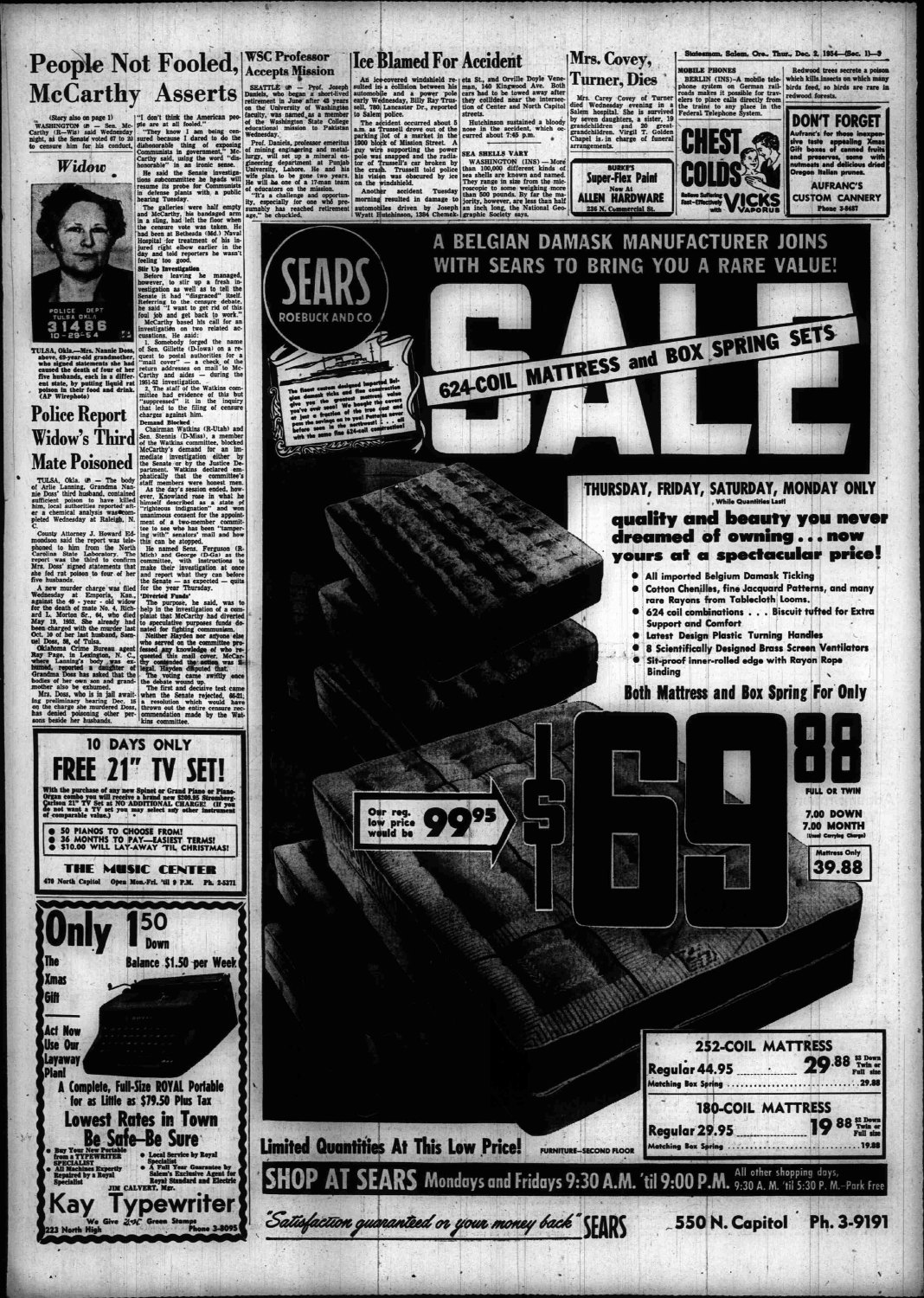
An Alabama-born woman whose 1954 arrest followed an arsenic finding in her fifth husband’s autopsy. Her confession crossed several states and included relatives as well as spouses, but only one murder produced a conviction.
Samuel Doss’s doctor regarded the rapid relapse after hospital discharge as suspicious and ordered an autopsy. Arsenic testing led to Doss’s arrest. Investigators in Oklahoma, Alabama, Kansas, and North Carolina then reexamined deaths, exhumed some remains, and found poison in several cases. Confessions supplied much of the broader attribution, but prosecutors concentrated the Oklahoma case on Samuel Doss.
Investigation and evidence
Samuel Doss’s doctor regarded the rapid relapse after hospital discharge as suspicious and ordered an autopsy. Arsenic testing led to Doss’s arrest. Investigators in Oklahoma, Alabama, Kansas, and North Carolina then reexamined deaths, exhumed some remains, and found poison in several cases. Confessions supplied much of the broader attribution, but prosecutors concentrated the Oklahoma case on Samuel Doss.
Legal outcome
Doss pleaded guilty in Oklahoma to one murder and received life imprisonment in 1955. Other states considered or filed charges, but she was never tried for the additional deaths. She died at the Oklahoma State Penitentiary hospital in 1965.
Victims and community context
Those attributed to Doss included spouses, her mother, a sister, and young descendants. The domestic setting made sudden illness appear private and ordinary, while fragmented state records limited pattern recognition. The familiar comic nickname trivializes a series of family deaths and should be secondary to the victims’ relationships and lost lives.
Why this case matters
Those attributed to Doss included spouses, her mother, a sister, and young descendants. The domestic setting made sudden illness appear private and ordinary, while fragmented state records limited pattern recognition. The familiar comic nickname trivializes a series of family deaths and should be secondary to the victims’ relationships and lost lives.